
UK–Poland trade hits £33.9 billion, but the bigger story is where growth could come next
- 16/09/2026
- Posted by: Admin
- Categories: Business Development, International, UK–Poland Trade
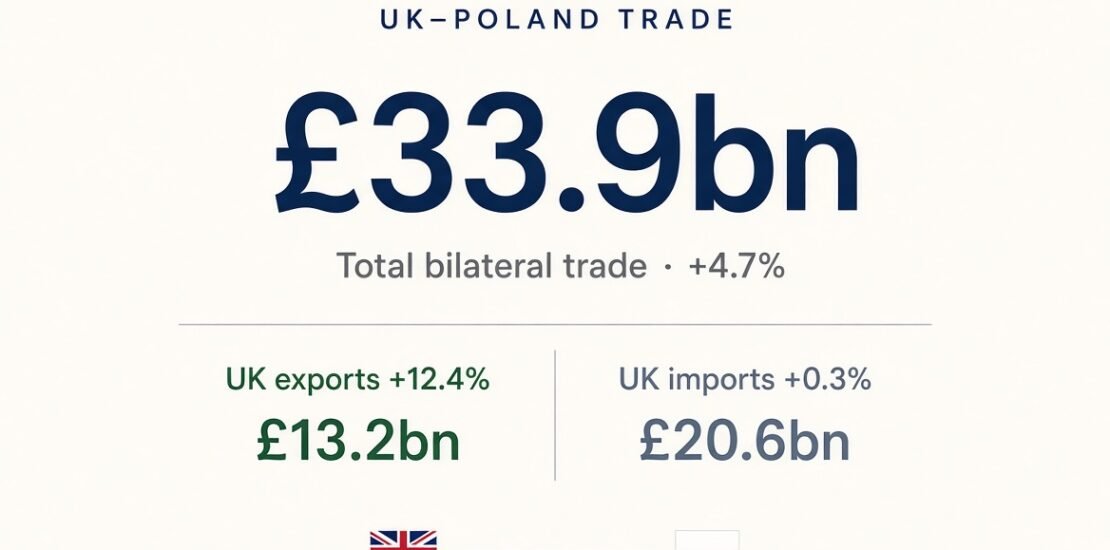
Trade between the United Kingdom and Poland has reached a new level. Total bilateral trade in goods and services was worth £33.9 billion in the four quarters to the end of March 2026, an increase of 4.7%, or approximately £1.5 billion, compared with the previous 12-month period.
That is an encouraging headline. Yet the most interesting part of the latest data is not simply that trade grew. It is the direction and pace of that growth.
UK exports to Poland increased by 12.4% to £13.2 billion, while UK imports from Poland rose by only 0.3% to £20.6 billion. Poland was the UK’s 16th-largest trading partner, accounting for 1.8% of total UK trade.
For businesses, the message is clear: Poland is no longer a market that UK companies should treat as a secondary Central European opportunity. It is becoming a substantial commercial destination in its own right.
A relationship that is becoming more balanced
Polish companies have built a strong position in the British market. Food, furniture, machinery, consumer goods, transport services and manufactured components are already familiar parts of UK supply chains.
The latest figures suggest that British companies are now becoming more successful in the opposite direction.
Although the UK continues to import considerably more from Poland than it exports there, the sharp increase in UK exports points towards a gradually more balanced commercial relationship. UK exporters gained approximately £1.5 billion in additional sales to Poland compared with the preceding four quarters.
This matters because export growth of 12.4% is unlikely to be explained by a single transaction or sector alone. It suggests wider demand for British products, services and expertise.
Poland has a large domestic market, an increasingly sophisticated business base and an important role in European manufacturing and distribution networks. For UK businesses, particularly those that have concentrated on larger Western European markets, it offers a combination of scale, industrial demand and room for differentiation.
Where are the commercial opportunities?
The immediate opportunity is not limited to shipping more physical products across the border.
British businesses may find attractive prospects in:
- Advanced manufacturing and industrial technology, including automation, specialist machinery, production software and quality-control systems.
- Professional and business services, particularly financial services, insurance, legal advice, engineering, certification and commercial consultancy.
- Energy and infrastructure, where the UK’s experience in offshore wind, project finance, nuclear energy, grid management and complex infrastructure may be relevant to Poland’s investment plans.
- Cybersecurity and digital transformation, as Polish companies modernise operations and strengthen the resilience of connected supply chains.
- Education and workforce development, including technical training, executive education and specialist professional qualifications.
The strongest market-entry proposition will rarely be “British” on its own. UK companies will need to show that they understand Polish purchasing processes, price expectations and business culture.
That could mean working through a distributor, appointing a Polish-speaking commercial lead, forming a local partnership or adapting a service to Polish regulatory and operational requirements.
Investment remains the missing piece
Trade is only one side of the economic relationship. Investment tells a more complicated story.
At the end of 2024, the stock of UK foreign direct investment in Poland stood at £6.9 billion, up 3.3% from the previous year. By comparison, the stock of Polish direct investment in the UK was only £448 million.
The difference is striking. Polish companies have achieved significant export success in Britain, but this has not yet translated into an equally substantial Polish investment presence.
That creates considerable headroom.
For established Polish exporters, acquiring or establishing a UK operation could provide direct access to customers, local warehousing, after-sales support and greater control over distribution. It could also help businesses move from contract manufacturing towards higher-value branded sales.
Potential routes into the UK include:
- Acquiring a smaller British distributor or competitor.
- Establishing a regional sales and service operation.
- Opening a warehouse or fulfilment centre.
- Forming a joint venture with a UK partner.
- Investing in manufacturing, assembly or product customisation closer to British customers.
The discrepancy between strong Polish exports and relatively modest Polish investment suggests that many companies are still serving the UK from Poland. That model can work, but a permanent British presence may become more attractive as businesses seek shorter delivery times, stronger customer relationships and more resilient supply chains.
What should UK companies do now?
The latest figures provide a reason to test Poland seriously, but not a reason to enter without preparation.
A sensible first step is to analyse existing customers and enquiries. Some UK companies may discover that Polish demand is already present but hidden within sales managed by European distributors or multinational accounts.
Businesses should then identify the Polish sectors in which their offer solves a clear operational problem. A targeted proposition for one industry is likely to perform better than a general message aimed at the entire market.
Pricing also requires careful attention. Poland is not simply a lower-cost version of another European market. Buyers may be price-conscious, but they will pay for technology, reliability and expertise when the commercial return is clear.
Finally, executives should consider Poland as both a sales market and a supply-chain partner. The opportunity may involve exporting a finished solution, sourcing components, collaborating on product development or using Poland as a production and distribution base for wider European operations.
The next chapter will be about integration
The £33.9 billion trade figure confirms that the UK–Poland economic relationship is already substantial. The 12.4% increase in UK exports shows that it is also changing.
The next stage is likely to be defined less by individual cross-border transactions and more by deeper commercial integration: joint ventures, acquisitions, local operations, technology partnerships and connected supply chains.
British businesses have an opportunity to build a stronger position in one of Europe’s most important markets. Polish companies, meanwhile, have room to convert their UK export success into a more permanent investment footprint.
The corridor is growing. The question for business leaders is no longer whether the opportunity exists, but where their organisation can capture it.